Hybrid Asset Management—Keep On-Prem, Get the Cloud

How to Get Cloud Benefits Without Leaving On-Prem Storage Behind
Is your team sitting on terabytes or even petabytes of on-premises content? You're not alone. Many media organizations have spent years building robust on-premises storage infrastructure, and for good reason: it's proven, controllable, and familiar. But the pressure to modernize is real. Remote teams need access, AI-powered search could transform your workflows, and competitors are already leveraging cloud capabilities. And for organizations whose content is spread across multiple cloud environments, the challenge isn’t just modernization, it’s unification.
A bring-your-own-storage Digital Asset Management (DAM) platform lets you keep existing infrastructure while adding the management layer your team needs. This centralized system lets your team manage, search, and distribute media assets across locations and workflows. The question isn't whether you need one. It's whether you need to abandon your existing infrastructure to get there.
The good news: you don't.
Why Are Some Businesses Hesitant to Switch from On-Prem?
Traditional all-or-nothing cloud migration approaches face four major obstacles that can stop projects in their tracks.
Cost Paralysis
Migrating content involves storage costs, bandwidth costs, implementation costs, and ongoing cloud storage fees. For large media libraries, the numbers can quickly add up.
Timeline Anxiety
A comprehensive media migration could take 12 months or longer depending on library size. When your distributed teams need to access media assets today, a year-long migration project becomes a competitive disadvantage rather than a strategic advantage.
Value vs. Urgency
Not all content has equal urgency. Your team's current project doesn't have the same migration priority as archived footage from the 1990s. Active projects need access today—decades-old archives probably don't.
IT Concerns
Understandably, IT teams may resist dismantling proven infrastructure. Control shifts from physical systems to cloud services, and teams need to adapt to new operational models. When migration means choosing between proven systems and modern capabilities, it's no wonder many organizations stay in analysis paralysis rather than taking action.
Most companies think they need to choose between a massive migration or staying limited to on-prem access. Luckily, there's a third option that's transforming how organizations approach their cloud migration strategy.
Meet the Hybrid Solution: S3-Compatible Connectivity
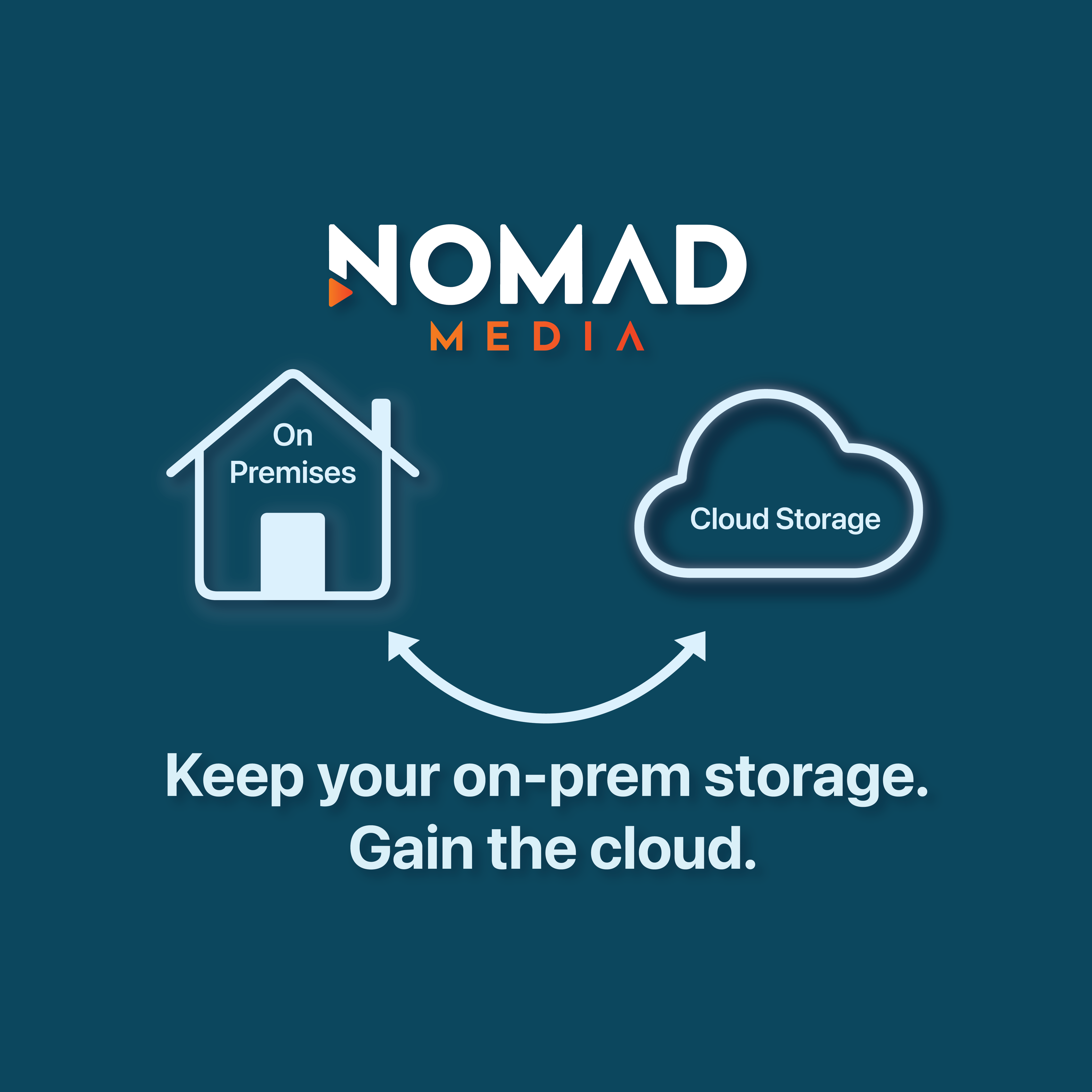
Migration doesn't have to be all-or-nothing. Many organizations are taking a hybrid cloud media storage approach—keeping what works on-prem while gaining cloud capabilities where they matter most.
Migration doesn’t have to be all-or-nothing. Many organizations are taking a hybrid cloud media storage approach, keeping what works on-prem, consolidating across cloud providers, or both, while gaining unified management capabilities where they matter most.
On-prem storage systems can connect to cloud environments using S3-compatible APIs—the same interface that Amazon Web Services (AWS) uses for S3 storage. A few popular systems include:
- On-premises storage: Ceph, MinIO
- Non-AWS cloud storage: Google Cloud Storage, Microsoft Azure Blob Storage, Oracle
Thanks to Nomad Media's advanced development model, if a cloud service supports S3-compatible APIs, it works with Nomad Media. This brings the management of your cloud and on-prem assets together in one powerful, easy-to-use interface.
Regardless of where your content lives—on-premises, in AWS, or in another cloud environment, it appears accessible through a single interface.
What This Means in Practice
- Connected offices and remote teams can browse your entire library and stream content through a cloud interface.
- Web-optimized proxy files enable global collaboration without exposing original high-resolution files.
- When you actually need to move content to the cloud, it's a simple drag-and-drop operation between storage locations.
- Searchable metadata and proxies stored in the cloud enable instant access without downloading originals.
- Your Active Directory security controls apply across all environments.
And critically: this is where AI starts to unlock real value. With your content connected to the cloud—even while physically remaining on-prem—cloud-based AI can begin analyzing and enriching it automatically.
Unlock AI-Powered Search Without a Full Migration
One of the most compelling reasons organizations pursue cloud migration is access to AI-powered content discovery. With a hybrid setup, you don't have to wait.
Once your on-prem content is connected through Nomad Media's S3-compatible interface, Nomad Media's intelligent search capabilities go to work on your entire library—not just what's already in the cloud.
Using Large Language Models, Nomad Media's search understands intent and context, not just exact keywords or tags. Instead of needing to know the precise filename or tag, your team can search naturally and find what they're looking for across decades of content, instantly.
This matters because the value locked in most media libraries isn't just operational, it's editorial, commercial, and archival. The ability to surface the right clip, the right moment, or the right piece of archival footage in seconds transforms how teams work and how organizations monetize their content.
What This Looks Like in the Real World
The hybrid approach isn't theoretical—organizations are already using it to solve the exact challenges described above.
A regional broadcast group managing seven TV stations came to Nomad Media with a common but costly problem: each station ran its own legacy systems independently, making content sharing between locations nearly impossible. Outdated on-premises equipment and aging tape archives made retrieving previously aired stories slow and expensive. Rather than forcing a disruptive all-or-nothing migration, Nomad Media deployed its cloud-native platform on AWS to standardize operations across all seven stations. Existing newsroom systems were integrated, video formats were converted, and all content became universally searchable and accessible—achieving 60–80% file size reductions and dramatically lower storage costs.
A similar story played out for a major live events organization facing two challenges at once: decades of legacy media locked in obsolete formats like VHS tapes, hard drives, and DVDs, and a need for scalable infrastructure to handle 900 terabytes of new digital content annually across its growing venue network. Nomad Media digitized and transcoded the legacy archive, implemented automated metadata generation, and established a centralized media repository using Amazon S3 and Glacier—all within three months of deployment.
In both cases, the organizations didn't have to choose between protecting what they'd built and gaining the capabilities they needed. They received both.
Getting Started with Unified Media Management
If you’re weighing a cloud vs. on-premises DAM, the good news is you don’t have to make an all-or-nothing choice. With Nomad Media's S3-compatible API support, you control what migrates and when, how much you spend, which teams get access, and on your own timeline.
Instead of asking, "Should we migrate to the cloud?" you get to ask, "Which assets need cloud access first?"
The organizations that are winning with media management aren't necessarily the ones who migrated fastest; rather, they're the ones who got smart about connecting what they have to what is possible.
Ready to gain cloud benefits without the migration headaches? Schedule a demo with the Nomad Media team and we'll help you get started.